
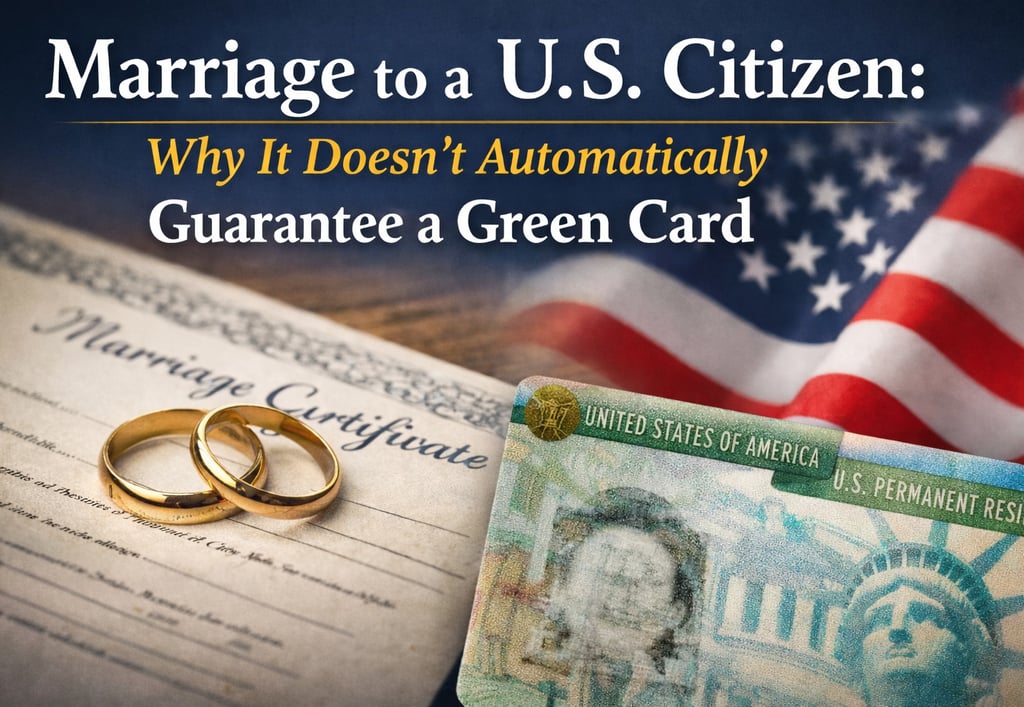
Marriage to a U.S. Citizen: Why It Does Not Automatically Guarantee a Green Card
While spouses of U.S. citizens are eligible to apply for lawful permanent residence as “immediate relatives,” approval depends on proving the marriage is genuine, meeting admissibility requirements, and successfully completing the U.S. immigration process with U.S. Citizenship and Immigration Services (USCIS).
Andrew Sones
2/2/20264 min read
Understanding Marriage-Based Immigration to the United States
Marriage to a U.S. citizen remains one of the most recognised pathways to permanent residence. Under the U.S. Immigration and Nationality Act (INA), a foreign national spouse is classified as an immediate relative, which offers important advantages:
No annual visa quota or waiting list
Potential to apply for Adjustment of Status using Form I-485 if lawfully present in the U.S.
Generally faster processing than most other family-based categories
However, eligibility is not the same as approval. USCIS must still determine that:
The marriage is legally valid
The relationship was entered in good faith, not for immigration purposes
The applicant is admissible under U.S. immigration law
If any of these elements are not satisfied, the Green Card application can be refused — even where the couple is genuinely married.
The Core Legal Process for a Marriage Green Card
Form I-130 – Petition for Alien Relative
The U.S. citizen spouse begins the process by filing Form I-130 with USCIS.
Approval confirms that the government recognises the qualifying relationship — but it does not grant permanent residence on its own.
Form I-485 – Adjustment of Status
If the foreign spouse is inside the United States and eligible, Form I-485 allows them to apply for permanent residence without leaving the country.
Applicants may also receive work authorisation and travel permission while the case is pending.
Consular Processing (If Outside the U.S.)
Where the spouse lives abroad, the case proceeds through the National Visa Center (NVC) and concludes with an interview at a U.S. Embassy or Consulate.
Biometrics, Background Checks, and Interview
USCIS evaluates:
Immigration and criminal history
Financial sponsorship via Form I-864 Affidavit of Support
Evidence that the marriage is bona fide
The interview stage is often decisive.
Proving a Genuine Marriage: What USCIS Really Looks For
A marriage certificate alone is insufficient.
USCIS assesses the totality of the relationship, including:
Joint tenancy agreements or property ownership
Shared bank accounts and financial activity
Insurance policies listing each other as beneficiaries
Photographs across time with family and friends
Travel history and shared experiences
Messages, correspondence, and day-to-day communication
Birth certificates of children, where applicable
Sworn statements from friends or relatives
The objective is to demonstrate a real shared life — not merely a formal ceremony.
Common Reasons Marriage-Based Green Cards Are Refused
Even authentic couples can face refusal where legal or evidential issues arise.
Insufficient Evidence of a Real Relationship - Limited joint documentation or inconsistent interview answers may lead USCIS to doubt the marriage.
Living Apart Without Strong Supporting Evidence - Separation is not automatically disqualifying, but it raises scrutiny and must be clearly explained.
Previous Immigration Violations - Overstays, unlawful presence, fraud, or prior removal orders may create inadmissibility requiring legal waivers.
Criminal History - Certain offences can prevent approval entirely.
Marriage opens the door to eligibility — but credibility and admissibility determine the outcome.
Conditional Residence and the Two-Year Review
If the marriage is less than two years old when permanent residence is granted, USCIS issues conditional residence valid for two years.
To remain a permanent resident, the couple must file:
Form I-751 – Petition to Remove Conditions on Residence
This stage again requires proof the marriage is genuine.
Failure to file correctly or on time can result in:
Loss of lawful status
Removal proceedings in U.S. immigration court
Key Misconceptions About Marriage and U.S. Immigration
“Marriage guarantees a Green Card.”
False. Approval depends on evidence, eligibility, and legal admissibility.
“The interview is just a formality.”
Incorrect. Interviews are detailed and can determine success or refusal.
“Love alone is enough proof.”
No. U.S. immigration decisions rely on documentary evidence and legal standards.
How to Strengthen a Marriage-Based Green Card Application
Practical steps that significantly improve approval prospects include:
Maintaining joint financial and residential records early in the relationship
Documenting shared experiences over time, not only wedding events
Preparing thoroughly for the USCIS interview with consistent, truthful answers
Addressing any immigration or criminal history before filing
Seeking experienced U.S. immigration legal guidance
Strategic preparation often determines success.
How Crownside Legal Supports British Families Moving to the U.S.
Marriage-based immigration is both powerful and highly scrutinised.
Proper legal preparation is essential to avoid delays, refusals, or future immigration complications.
Crownside Legal, led by U.S. immigration attorney Andrew R. Sones, assists British individuals and families with:
Forms I-130, I-485, and I-751 preparation and filing
Consular processing at the U.S. Embassy in London and worldwide
Evidence strategy to prove a bona fide marriage
Interview preparation and inadmissibility waiver analysis
Long-term planning toward U.S. citizenship (Form N-400)
Early guidance can prevent costly mistakes and significantly improve the likelihood of approval.
Frequently Asked Questions
Does marrying a U.S. citizen automatically give me a Green Card?
No. Marriage allows you to apply, but USCIS must still approve the petition, confirm the marriage is genuine, and determine you are admissible.
How long does a marriage-based Green Card take?
Processing times vary, but many cases take approximately 10–24 months, depending on location and complexity.
Can I remain in the United States while my case is pending?
Yes, if you properly file Form I-485, you may stay in the U.S. and often receive temporary work and travel authorisation.
What happens if my marriage is less than two years old?
You will usually receive conditional residence and must later file Form I-751 to obtain permanent status.
Speak With a U.S. Immigration Lawyer Experienced in UK-to-U.S. Cases
If you are considering applying for a U.S. Green Card through marriage, obtaining clear legal advice at an early stage can make the difference between approval and refusal.
You can learn more about Crownside Legal at:
https://usalaw.co.uk/about
Or schedule a free consultation with Attorney Andrew R. Sones:
http://www.calendly.com/crownside
Professional guidance ensures your application is prepared correctly, supported by strong evidence, and aligned with current U.S. immigration law — giving you the best possible path toward life in the United States.