
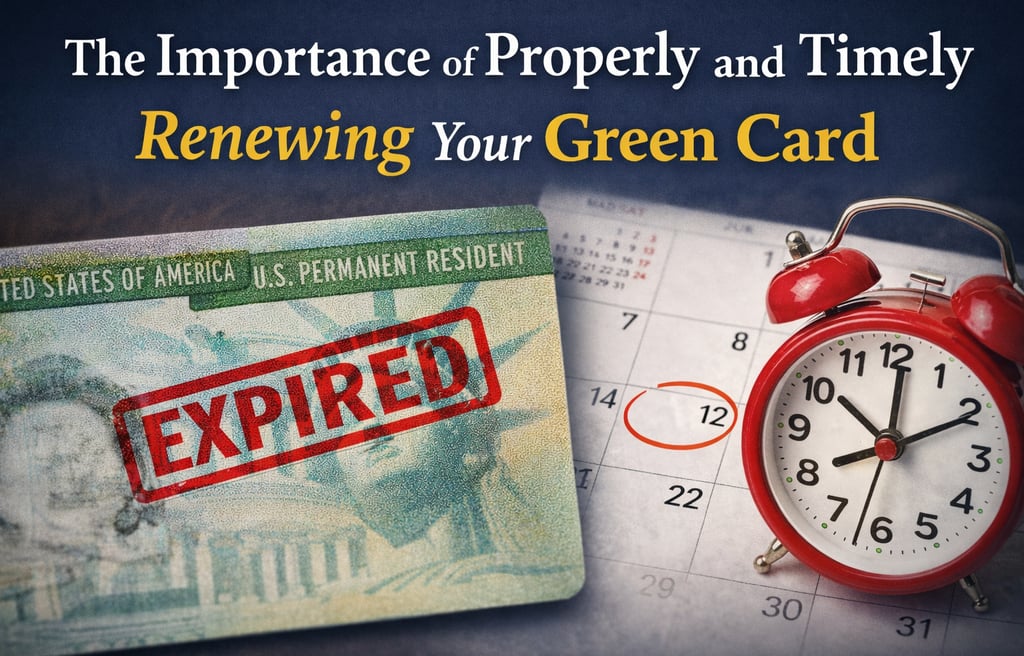
The Importance of Properly and Timely Renewing Your Green Card
Yes — most permanent residents must renew their Green Card on time to avoid travel, employment, and legal complications. Although lawful permanent resident status itself does not expire, the physical Green Card typically expires every 10 years and must be renewed using Form I-90. Conditional residents must instead file Form I-751 or Form I-829 within strict deadlines.
Andrew R. Sones Esq.
2/5/20262 min read
Why Renewing Your Green Card Matters
Because the Green Card is the primary proof of lawful permanent residence, an expired card can immediately affect:
Employment eligibility verification
International travel and airline boarding
Driver’s licences and government services
Financial and identity verification
Timely renewal prevents avoidable disruptions to everyday life in the United States.
When You Must Renew a 10-Year Green Card
Most permanent residents receive a card valid for 10 years. Renewal is completed using:
Form I-90 — Application to Replace Permanent Resident Card
USCIS recommends filing within six months before the expiration date. Waiting longer can create travel delays, employment issues, and administrative complications.
Conditional Residents Have Different Deadlines
Residents who obtained status through a recent marriage or certain investment categories receive a two-year conditional Green Card.
They must file:
Form I-751 — Petition to Remove Conditions on Residence
Form I-829 — Investor Petition to Remove Conditions
This filing must occur during the 90-day window before expiration.
Missing the deadline can lead to termination of status and removal proceedings.
Risks of Letting Your Green Card Expire
Employment interruption
Difficulty re-entering the United States after travel
Delays with licences or public services
Increased immigration scrutiny
Even though status may technically continue, practical consequences can be severe.
What If Your Green Card Is Already Expired?
You can still renew it.
Expiration alone does not cancel permanent resident status. However, long delays may require additional proof of continued U.S. residence or emergency temporary evidence such as an I-551 stamp.
Renewal vs. Applying for U.S. Citizenship
Some permanent residents may qualify for naturalisation using:
Form N-400 — Application for Naturalisation
Citizenship removes the need for future renewals and provides full legal rights, including a U.S. passport and voting eligibility.
Where eligible, citizenship is often the stronger long-term option.
How Crownside Legal Assists Permanent Residents
Crownside Legal, led by U.S. immigration attorney Andrew R. Sones, supports clients worldwide with:
Form I-90 Green Card renewals
I-751 and I-829 removal of conditions
Emergency proof-of-status appointments
Naturalisation strategy and Form N-400 filings
Travel and abandonment risk analysis
Frequently Asked Questions
Do I lose permanent residence if my Green Card expires?
No. Status usually continues, but renewal should be completed quickly to avoid problems.
How early should I file Form I-90?
Within six months before expiration is recommended.
What happens if I miss the I-751 deadline?
Status may be terminated, but legal remedies may still exist if addressed promptly.
Should I renew or apply for citizenship?
If eligible, citizenship is often the better long-term solution.
Speak With a U.S. Immigration Lawyer
Learn more about Crownside Legal:
https://usalaw.co.uk/about
Schedule a free consultation:
http://www.calendly.com/crownside
Professional legal guidance helps ensure your status remains secure and your future in the United States stays protected.